
Riding Out the Perfect Storm: Why Tape Storage Is the Strategic Lifeboat for Modern Data Management
- Kevin Thomas

- Dec 17, 2025
- 6 min read
Updated: Dec 23, 2025
We are in the middle of a Perfect Storm, and the waves are getting bigger.
Across the tech landscape, three powerful forces are crashing together: hardware shortages, energy and water constraints, and runaway data growth. Each of these would be disruptive on its own. Together, they are reshaping how organizations think about infrastructure — especially how and where they store their data.
Hardware Shortages
Start with the supply chain. The rise of AI and hyperscale workloads has caused an unprecedented surge in demand for flash and hard disk drives. Manufacturers simply cannot keep up. High-capacity enterprise HDDs are backordered by months, in some cases, years. Flash prices are spiking. Even hyperscalers are scrambling, pushing their allocations to the limit and resorting to alternatives to stay online. For everyone else, it means longer wait times, higher costs, and fewer options.
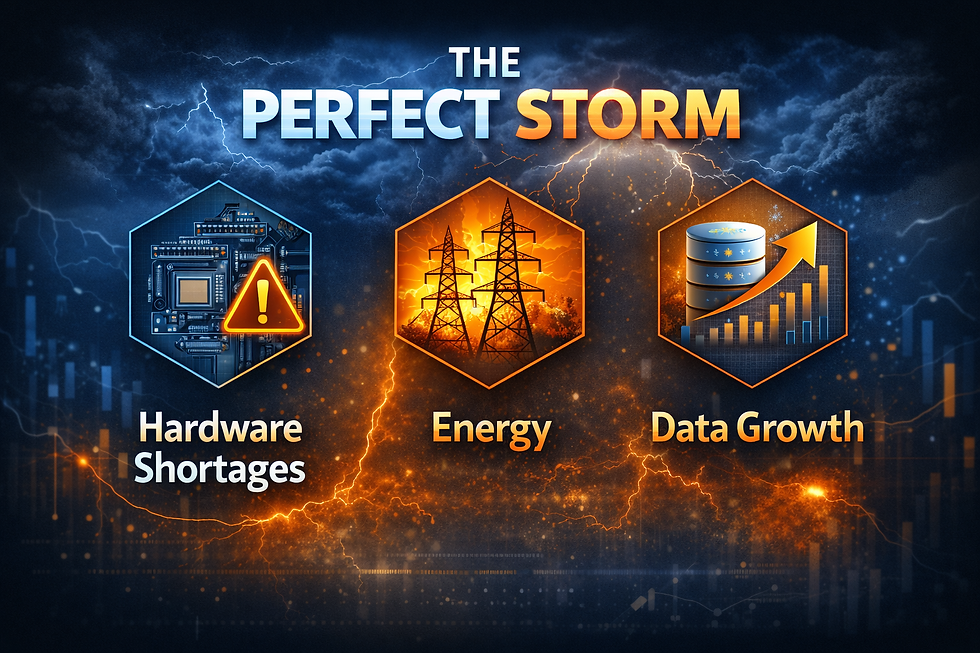
Energy
Meanwhile, data centers are running headfirst into a wall: power.
The infrastructure that powers our digital world is now under scrutiny from regulators, city councils, and even neighborhood coalitions. Across the U.S. and globally, data centers are being rejected, delayed, or throttled, not because of their technology, but because of their impact.
Power grids are strained. Water supplies are being questioned. And communities are asking a sharp but straightforward question: Is this worth it?
Data Growth
All of this is happening as data volumes explode. Every enterprise is collecting, generating, and storing more data than ever before. Most of the data sits idle, untouched, costing money, consuming power, and taking up space on infrastructure that was built for performance, not retention.
The result?
A strategic contradiction. Companies are being asked to scale storage at a time when they cannot get the hardware, cannot turn on more power, and cannot expand their physical footprint, all while the data keeps coming.
This is not a short-term squeeze. It is a multi-year reality. And it demands a more innovative strategy.
Old Tech, New Relevance
In an industry obsessed with what is next, it is easy to overlook what is already working.
Tape storage is not new. It has been the quiet workhorse of enterprise data for decades; reliable, scalable, and secure. But in today's environment, it is not just relevant again, it is essential. In fact, tape is uniquely suited to address every element of the Perfect Storm. And to be clear, this is not the tape technology of 20 years ago. Modern formats like LTO-10 can store up to 40 terabytes of uncompressed data on a single cartridge, with advanced encryption, ultra-fast data transfer speeds, and a roadmap that scales well into the future. Tape has evolved and is built for today's data demands.
Start with energy.
Tape consumes up to 90 percent less power than disk. Unlike spinning drives, which need to stay online and continuously draw power to maintain access, tape only consumes energy when data is written or read. Idle tape sits in a vault or a robot, consuming zero power. In a world where energy is scarce, expensive, and politically sensitive, that is a strategic advantage you can measure in kilowatts — and in dollars.
Then there is availability.
While flash and HDD supplies are constrained, tape is not. Manufacturing capacity is stable. Lead times are short. Unlike flash, tape has not been cannibalized by the AI surge. It is sitting on the shelf, ready to deploy. For IT teams stuck waiting on backorders or reshuffling their storage forecasts, this is a rare bright spot.
Storage Strategy
And perhaps most importantly, tape changes the math on what gets stored where.
The truth is, not all data needs to be on high-performance infrastructure. In fact, most of it should not be. Studies show that up to 80 percent of enterprise data goes cold within 90 days. Yet, it remains on expensive, power-hungry disk and flash arrays. That is not just wasteful — it is unsustainable.

Tape gives organizations the opportunity and the incentive to be smarter. Move cold data to tape. Free up valuable disk and flash capacity. Delay new hardware purchases. Reduce power draw. Lower the data center's energy footprint without deleting a single file.
In short, use tape not as a backup plan, but as a strategic tier in a modern storage architecture. One that is optimized not just for performance, but for resilience to cost volatility, supply shortages, and energy pressure.
Data Management as a Survival Strategy
This moment is not just about storage. It is about strategy.
The companies that will navigate the next two to three years successfully are not the ones with the biggest budgets or the flashiest infrastructure. They are the ones who rethink what their data actually needs and align their storage approach to reality, not legacy habits.
That starts with asking a few hard questions.
What percentage of your data is active?
What is sitting idle but still taking up space, power, and budget?
How much of your capacity is cold data that has not been touched in months?
And what would it mean, financially and operationally, if that data lived somewhere else?
This is where modern tape shines. It provides a low-power, high-capacity, cost-stable landing zone for cold data. And when you pair it with the right data management practices, it becomes a pressure release valve for your infrastructure. Tape allows you to:
Free up disk and flash capacity.
Reduce your energy draw.
Delay new hardware purchases, as you cannot even get them right now. Lower the cooling load.
Avoid the need to expand your data center footprint. And as an added benefit, it reduces exposure to public and regulatory pressure about environmental impact.
It is not just smart. It is survival.
And now, thanks to OpEx-based consumption models like those offered by Geyser Data, it is also easy to act.
No forklift upgrades.
No massive capital spend.
No waiting for supply chains to clear up.
Just a better way to manage your cold data, right now.
Tape has always been reliable. Today, it is also available, affordable, and aligned with the realities of this moment. And with an OpEx model, organizations can make the shift quickly, with flexibility and control.
Ride Out the Storm, Without Reinventing Your Team
For years, the biggest knock against tape was not its capability, but its complexity. Managing libraries, loading media, and navigating retention workflows required a level of operational knowledge that many modern teams no longer have. For some organizations, especially those with deep infrastructure teams or specific compliance needs, hosting and managing tape on-premises is still absolutely the right choice. But for many others, especially those without in-house tape expertise or who want to avoid the operational overhead, a fully managed, as-a-Service model offers the same benefits without the burden.
But that is precisely what has changed.
With modern cold data and archive services from companies like Geyser Data, you no longer need in-house tape experts. You do not need to manage hardware. You do not need to retrain your team. And you definitely do not need to compromise on simplicity.
With our as-a-Service model, your archive shows up just like any other storage target in the cloud. But behind the scenes, it is built on tape, giving you all the benefits of low cost, ultra-low energy use, and rock-solid reliability.
This is not just cloud storage. It is a smarter cloud.
Because, unlike the public cloud:
Your data is private with Geyser. Your tapes are dedicated to you, not shared across thousands of tenants like you'll find in the public cloud services.
There are no retrieval fees, no egress fees, no lock-in, and no multi-day delays to get your own data back. In most cases, data recovery is measured in hours, not days.
You get the scale and ease of the cloud, with the economics and security of tape, without the complexity that held people back in the past.
So yes, the storm is real.
The constraints are real. But the solutions are too. And they do not require a data center overhaul, a hiring spree, or a capital commitment. They just require a smarter strategy for cold data, one that is ready today.
Geyser Data is here to help you ride it out. And come out stronger.
Let's talk.
Is your cold data still sitting on hot infrastructure? Let's move it in 2026.
Comments